What Is a Demand Charge on a Commercial Electric Bill?
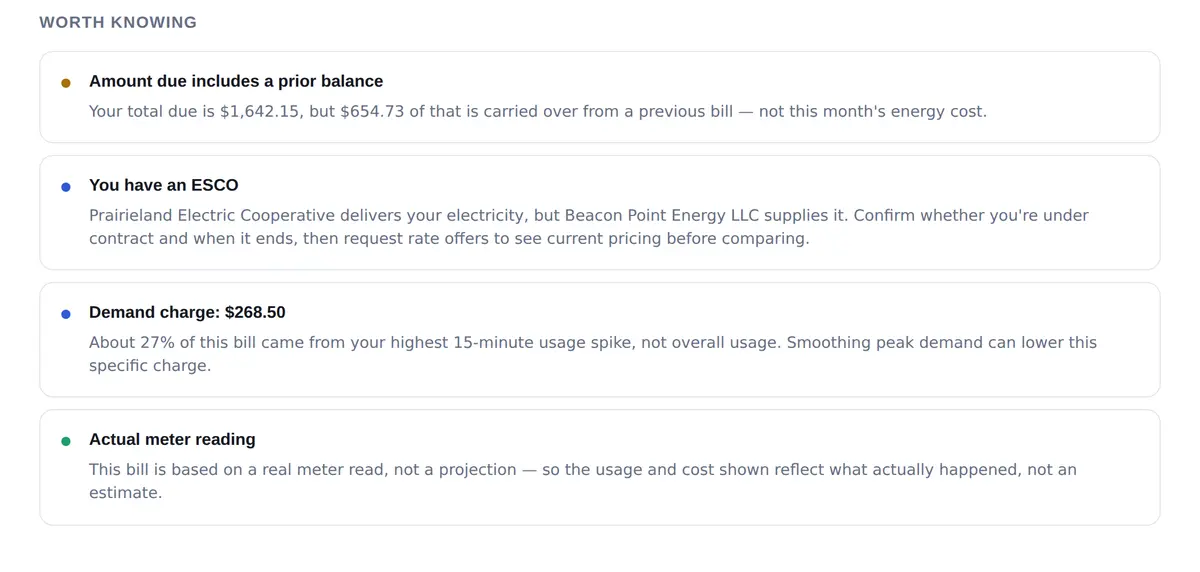
A demand charge bills a business for the single highest burst of power it drew during any 15– or 30-minute window in the billing period — not total usage — which means it’s driven by when equipment turns on, not how much it runs overall.
How it’s different from a usage charge
Most residential bills only charge for total energy consumed (kWh). Many commercial and industrial bills add a second charge based on peak demand (kW) — the highest rate of power draw recorded during any short interval in the billing period, measured separately from total consumption. Two businesses that use the exact same total kWh in a month can have very different demand charges if one runs equipment steadily and the other has all its equipment start up at once. Utilities bill this way because it's a real cost driver on their end: the size of transformers, substations, and power lines a utility has to build and maintain is set by the highest load anyone might place on the grid at once, not by average usage — so a demand charge is the utility’s way of recovering the cost of having that capacity ready, even if it only gets used for a few minutes a month.
What usually causes a demand spike
- Multiple large pieces of equipment (HVAC, refrigeration, motors, ovens) starting up within the same few minutes, often at opening.
- A single very high-draw device — a walk-in cooler compressor, an industrial motor, a commercial oven — cycling on.
- Poorly staggered schedules where equipment isn’t sequenced to avoid overlapping startup.
How to lower a demand charge
Because it’s driven by timing rather than total usage, the fix is usually to stagger equipment startup rather than to simply use less energy overall. Soft-start controllers on large motors, staggered opening sequences, and building automation systems that ramp equipment on gradually rather than all at once are the standard approaches, and they typically reduce the demand charge without reducing total output or comfort. If your utility also runs time-of-use pricing on the energy (kWh) side of the bill, there's a second lever worth pulling alongside staggering equipment: on-peak energy charges are priced higher than off-peak ones, so shifting flexible, non-time-sensitive loads (like running equipment cycles or charging fleet vehicles overnight) to off-peak hours can lower both the energy charge and, often, the demand charge at the same time, since off-peak periods are also when the grid has the most spare capacity.
Frequently asked questions
Do residential electric bills have demand charges?
Rarely — demand charges are mostly a commercial and industrial billing structure, though some utilities are piloting them for residential customers with high-draw equipment like EV chargers.
How much of a commercial bill can demand charges be?
It varies by utility and business type, but industry estimates commonly put demand charges at roughly 30% to 70% of a commercial electric bill, and they can be the single largest line item for facilities with spiky equipment use.
Can I see my demand charge on my bill?
Yes — look for a separate line item measured in kW (not kWh), sometimes labeled "demand," "peak demand," or "kW demand charge," distinct from the kWh usage charge.
See this on your own bill
Upload your electric or gas bill and Certo reads it for you — a free bill health score, a plain-English breakdown, and whether your rate is competitive.
Want it tracked automatically every month?
Plus and Pro track bill history, flag rate hikes and unusual usage, and (on Pro) build a custom efficiency checklist and savings tracker — so you're not re-checking this by hand.