How to Read Your Eversource Bill
Eversource delivers electricity and, in some territories, natural gas across Massachusetts, Connecticut, and New Hampshire. Your bill splits into a supply charge (the energy itself) and a delivery charge (getting it to you) — and depending on your state, the supply portion may be shoppable through a competitive supplier or municipal aggregation program while Eversource keeps handling delivery either way.
Supply vs. delivery
Eversource describes the split simply: supply charges pay for the actual electricity you use, while delivery charges — sometimes broken out separately as distribution and transmission — fund the poles, wires, substations, and maintenance that get power from the grid to your property. It's often compared to paying for a product versus paying for its shipping and handling. Delivery charges stay with Eversource regardless of who supplies your energy; only the supply charge can move to a different provider where the market allows it.
Competitive supply and municipal aggregation
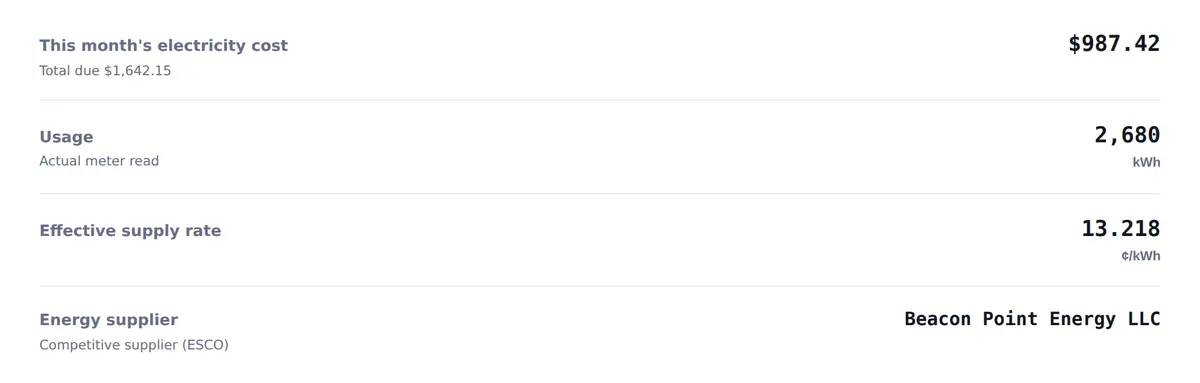
Because Massachusetts, Connecticut, and New Hampshire each run some form of deregulated or partially deregulated electricity market, Eversource customers in many areas can choose a competitive supplier for the energy portion of their bill instead of staying on Eversource's own default supply rate. Some Massachusetts and Connecticut communities also run municipal aggregation programs, which can automatically place residents on a locally negotiated supply rate unless they opt out — worth checking your bill's supplier line for, since you may already be on one without having signed up yourself.
The smaller line items
Below supply and delivery, an Eversource bill typically includes several smaller riders that vary by state and change periodically — things like Revenue Decoupling Charges, Distributed Solar Charges, and Renewable Energy Charges. These fund specific state programs and infrastructure investments, and while each one is usually modest on its own, they can add up, especially in a low-usage month when they make up a larger share of the total bill relative to actual energy used.
Comparing a competitive offer
If you're weighing a competitive supplier's quote, compare its per-kWh price against your current Eversource supply rate from a recent bill — not a rate from last year — and check whether the offer is fixed or variable, and for how long. A fixed rate can offer predictability through a high-usage season, but it isn't automatically cheaper than what you're already paying.
Frequently asked questions
What's the difference between supply and delivery on an Eversource bill?
Supply charges pay for the electricity itself; delivery charges (also called distribution and transmission) pay for the poles, wires, and infrastructure that carry it to you. Delivery charges stay with Eversource no matter who supplies your energy.
Can I choose a supplier other than Eversource?
In many of Eversource's New England territories, yes — the electricity market is deregulated or partially deregulated, meaning competitive suppliers or municipal aggregation programs can supply the energy portion while Eversource continues to handle delivery.
What are the smaller charges on an Eversource bill, like Distributed Solar or Renewable Energy charges?
These are riders that fund specific state programs — solar incentives, renewable energy requirements, revenue decoupling adjustments, and similar line items — and they vary by state and can change from year to year. They're usually smaller than the supply and delivery charges but are worth checking on a bill that looks unexpectedly high.
See this on your own bill
Upload your Eversource bill and Certo reads it for you — a free bill health score, a plain-English breakdown, and whether your supply rate is competitive.
Want it tracked automatically every month?
Plus and Pro track bill history, flag rate hikes and unusual usage, and (on Pro) build a custom efficiency checklist and savings tracker — so you're not re-checking this by hand.